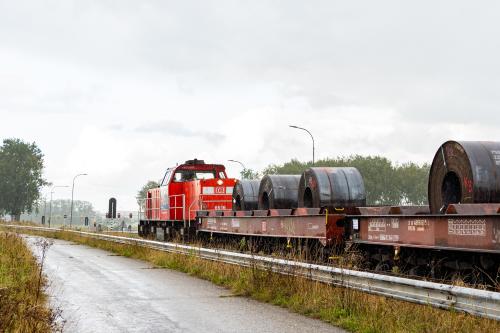
The Netherlands and Belgium recently signed a Memorandum of Understanding to this end. The Ghent–Terneuzen rail link is one of the rail projects on which both countries agreed in early 2026 to cooperate more closely.
Enhancing rail reliability
With the project agreements set out in the Memorandum and the subsequent decision to launch a (Dutch) MIRT study, ProRail (on the Dutch side) and Infrabel (on the Belgian side) can now get started. They will investigate how the (capacity) bottlenecks on the rail network in North Sea Port can be addressed. The reliability of the rail network must also be improved, so that rail freight transport is, and remains, an attractive alternative for shippers. This will mean fewer lorries on the roads and more goods being transported in a more sustainable manner. North Sea Port is a key link within the European transport network. The port faces a major sustainability challenge, in which the rail network plays a key role by making transport more sustainable and efficient.
When it comes to promising measures, particular attention is being paid to closing the ‘missing link’ between Axel and Zelzate, constructing a south-eastern bypass at the Sluiskil Bridge, and the northern access and extension of the Zandeken rail cluster at the Kluizendok.
Public engagement on the Dutch side of the border
After the summer of 2026, the local community (on the Dutch side of the border within our port area) will be informed about the rail project, and the public engagement process will also begin. The feasibility study is expected to be completed by the end of 2028. The study will identify promising solutions. At the end of the study, a preferred option will be selected and further developed.
A total of 240 million euros has been allocated for the rail project, divided equally between the Netherlands and Belgium. On the Dutch side, the funding for this feasibility study comes mainly from the National Growth Fund, alongside funds from the ‘Wind in de Zeilen’ compensation package and the Connecting Europe Facility (CEF) grant. This decision to proceed therefore does not prejudge the prioritisation of the Mobility Fund (and the Delta Fund).
Dutch State Secretary Annet Bertram (Infrastructure and Water Management) said: “The North Sea Port area is of great importance to the economies and employment in Zeeland and the Netherlands. It is essential that we work together to boost the rail links and, consequently, industry in the Ghent and Terneuzen Canal Zone. We are now taking a truly significant step towards this.”
Belgian Minister Jean-Luc Crucke (Mobility, Climate and Ecological Transition): “Rail freight transport plays a vital role in strengthening our economic competitiveness and in achieving our ecological transition targets. North Sea Port is a strategic logistics and industrial hub for Belgium and Europe. I am delighted with the excellent cooperation between the Belgian and Dutch authorities and between the infrastructure managers. I hope that the studies currently being carried out will identify the best and most realistic solutions for sustainably strengthening the rail links between Ghent and Terneuzen.”
Closer cooperation
At the start of this year, the Netherlands and Belgium agreed to cooperate more closely on rail transport. The aim is to speed up progress on a number of rail projects, such as the Ghent–Terneuzen rail link. Geopolitical and economic relations are changing rapidly, and this calls for greater cooperation in areas including accessibility, safety and military mobility.